27 July 2026
How the Boardingly Worldly Ranking works
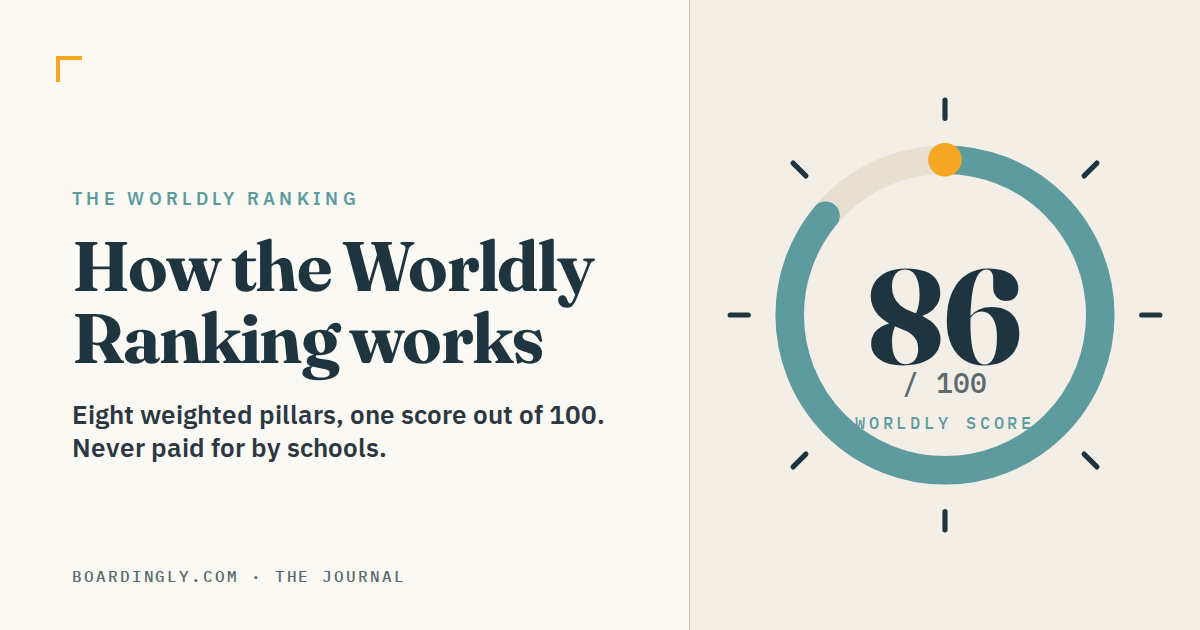
Every league table answers the same question: who did this school let in? Sort by exam results and you have mostly sorted by admissions policy. The most selective schools take the strongest pupils and, unsurprisingly, post the strongest grades. The table calls that quality. We call it circular.
The Boardingly Worldly Ranking asks a different question. Not who a school admits, but what it does with them. It is a single score out of 100, built from eight weighted pillars, and no school can pay to move it.
What is the Boardingly Worldly Ranking?
It is an evidence-based score, from 0 to 100, of how well a school develops a worldly child: one ready to go into the world happy, creative, financially literate, cross-culturally aware, high in empathy and socially minded. Each of eight pillars scores out of 100 from publicly sourced data, then rolls up by fixed weights into one composite number.
The score is the same for every family. It measures the school, not your child. Matching your child comes after, once you have added their type to their profile.
The eight pillars, and what each weighs
The weights are fixed. They are the same for every school and every reader. A stronger academic record counts for more than a stronger staffroom sentiment, and the table says so plainly.
| Pillar | What it measures | Weight |
|---|---|---|
| Brains Trust | Academic results, subject breadth, exam outcomes | 25% |
| Forward Thinking | Innovation in curriculum, technology, teaching | 15% |
| Alumni Power | The reach of who the school actually produces | 15% |
| Bragging Rights | Standing and regard among peers and the sector | 10% |
| Trophy Cabinet | Awards and competitive wins, in and out of the classroom | 10% |
| In the Public Eye | Press coverage: how often, and how well | 10% |
| Parent Views | What current and former parents actually say | 10% |
| Staffroom View | The view from inside, not the boardroom | 5% |
Academic strength carries the most weight, at a quarter of the score. But it is a quarter, not the whole. A school can post brilliant results and still score modestly if it does little for a child beyond the exam hall. That is the point.
Why it isn’t another league table
A league table measures the intake. The Worldly Ranking tries to measure the formation. Those are different things, and confusing them is how families end up at a celebrated school that does not fit their child.
Take two schools with identical A-level results. One runs genuine research partnerships with a university and sends pupils to national competitions. The other coaches hard to the exam and little beyond it. The league table cannot tell them apart. The Worldly Ranking can, because Forward Thinking, Trophy Cabinet and the rest carry weight the table ignores.
That is the defended position here. Results tell you who a school admitted. They tell you very little about what the school will do with your particular child over five years.
Why schools never pay
We take no money from schools, ever, in exchange for their score or their place in it. This is not a courtesy. It is the whole product.
The moment a school could buy a better number, the number would be worth nothing, and every family would be right to ignore it. We represent the family, not the school. The ranking earns its keep only by being honest, so it stays free of the people it judges.
What happens when the data is thin
Missing evidence is not a free pass. If a pillar has no reliable public signal, it scores zero and still counts at full weight. Sparse data pulls a score down rather than being quietly excused. Each school also carries a coverage figure, so you can see how much of the picture is built on real signals rather than gaps.
This keeps the score honest in the other direction too. A school cannot look strong simply because we know little about it.
How to use the score
Use it early, to build a list, not late, to settle an argument. A high Worldly Ranking earns a school a place on your shortlist. It does not end the decision. The decision belongs to you, once you have weighed the score against your child’s type, the fees, the location and the visit.
Add your child’s type to their profile and the ranking gains a second layer: the schools that suit your child rise to the top, not just the schools that score well in the abstract.
See how your child’s type sharpens the ranking →
The full method, pillar by pillar, sits on the Boardingly Worldly Approach page.
Frequently asked questions
Is the Worldly Ranking the same as a school’s exam results?
No. Academic results are one pillar, Brains Trust, worth 25%. The other 75% covers innovation, alumni, standing, awards, press, parent views and the staffroom.
Do schools pay to appear or to rank higher?
Never. No school pays for its score or placement. If that ever changed, the ranking would be worthless, so it won’t.
Why is one school’s score lower despite good results?
Because results are a quarter of the score. A school strong on exams but thin on the other seven pillars will score lower than one that is strong across the board.
Does the ranking tell me which school is right for my child?
Not on its own. The score measures the school. Add your child’s type to their profile and Boardingly layers fit on top, so you see the schools that suit your child, not just the highest scorers.
The number is a starting question
A ranking is only ever a good first question, never the last word. The Worldly Ranking is built to get you to a better shortlist faster, and to be honest about how it got there. What it will not do is make the decision for you. That still belongs to the people who know the child.