Plymouth College
Plymouth, Devon, United Kingdom
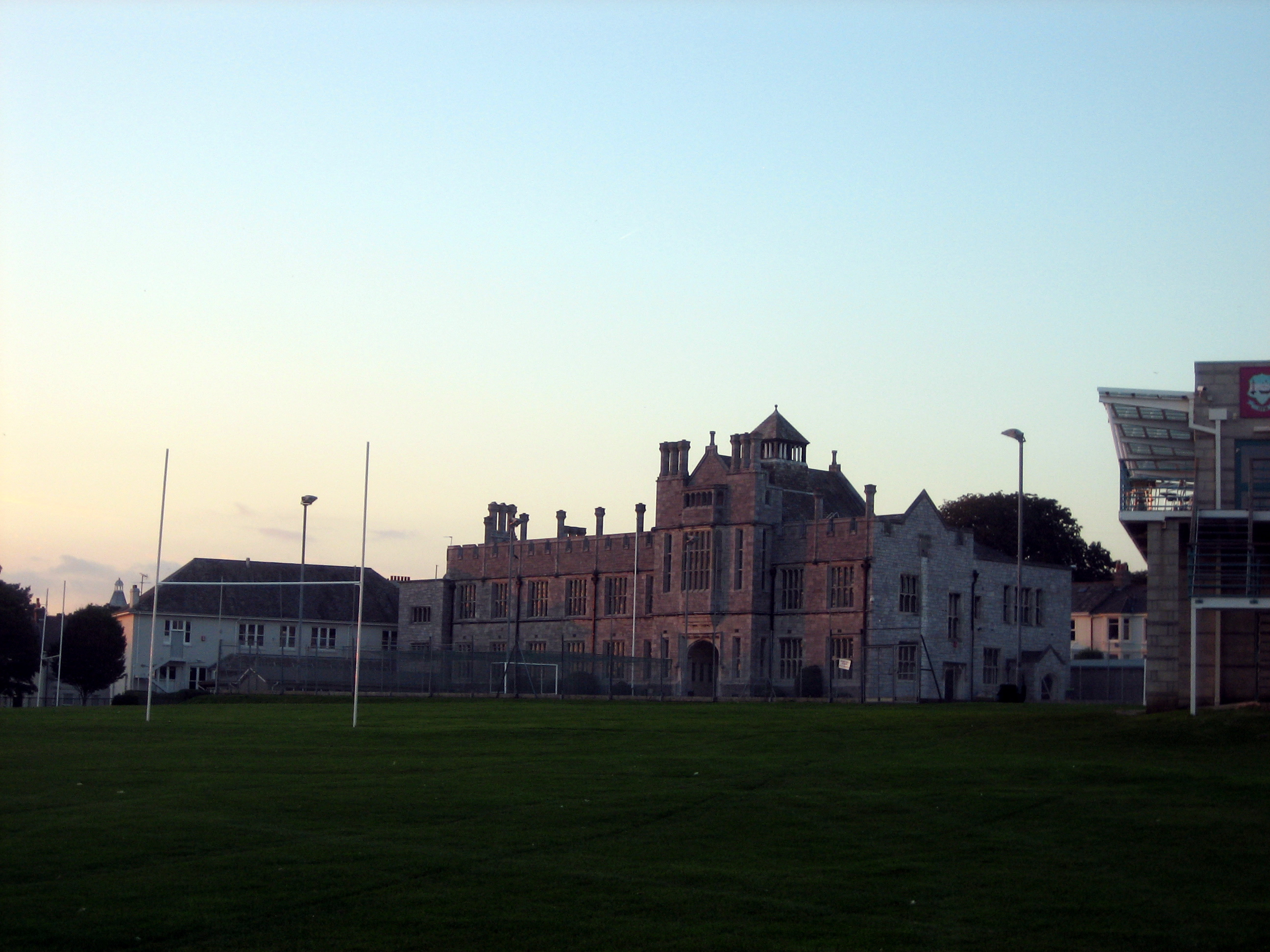
Photo: Oswaldbeldridge · Public domain
Boardingly Worldly ranking
Boardingly’s assessment — an estimate from public data, not a statement of fact about the school. How we score.
The Worldly ranking measures a school's external standing from publicly sourced signals — academic results, press coverage, alumni and awards — scored out of 100. Signal coverage: 65%.
About this school
There is a plaque somewhere at Plymouth College that a boy called Tom Daley must have walked past on his way to the pool, and the fact that a diver who won Olympic bronze at fourteen came out of this school in the heart of Devon is the first thing anyone will tell you about the place. It is also the thing you should be most careful about, because a single extraordinary talent can throw a warm glow over an entire institution and tell you very little about the school a more ordinary child would actually enter. Founded in 1877, absorbing Plymouth Mannamead School (older still, at 1846) and later St Dunstan's Abbey, this is a co-educational school of 511 pupils spanning ages 3 to 18. That headline roll, however, is where an international family must slow down and ask the only question that matters first.
Before anything else, establish the boarding community, because for a family flying a child across a continent, the boarding community is the product. A school can be admirable in a hundred ways and still be the wrong place if your son or daughter arrives to find a half-empty house on a Friday night. So ask, plainly and in writing, how many pupils board full time, and in which year groups; what the split is between full, weekly and flexi boarding; how many nationalities are represented; how many pupils remain on site from Friday evening to Sunday. Ask what the weekends actually contain and how long the housemasters and housemistresses have been in post. If the full-boarding group in your child's year turns out to be thin, or if the boarders are clustered in one or two year groups, then this should not be a first-choice boarding option for an overseas family, however good the diving. Sport cannot compensate for an absence of peers.
If those numbers come back healthy, the case for the place becomes genuinely interesting. What Plymouth College does with conviction is high-performance sport, and it does not pretend otherwise. The school claims more than 200 pupils who have competed at world level, a figure worth interrogating rather than swallowing whole, since much depends on how "world level" is defined and how much of it reflects current provision rather than history. But a school able to hold a serious young athlete's training around a serious academic timetable has built something particular, and it has built the pastoral structure such a life demands. Here, too, be specific. Daley's success owed a great deal to talent, family and coaching well beyond the school gates, so do not assume his path is a template. Ask instead about the pathway your own child would enter: which sports are strongly supported now, who the coaches are, how fixtures and injury and academic stretch are balanced, and where recent sporting leavers have gone. The honest reading is that this is a school built around water more than anything else. For a swimmer or a diver with real ambition, that focus is a gift. For a serious athlete in another discipline, test whether the machinery genuinely extends to them or only appears to. And for a child with no sporting drive at all, ask candidly whether the water sets the temperature of the whole place, or whether other kinds of achievement are equally at home in it.
On formation more broadly, the signs are encouraging where they can be found. The staffroom sentiment reading sits at 72 out of 100, a proprietary measure to be treated as a hint rather than a verdict, but a useful one, because teachers who feel well-treated tend to stay, and continuity of adults is one of the quieter engines of a child's character. Test it directly. Ask about staff turnover, about how long house staff have been in place, and about what pastoral care means at nine o'clock at night when an eleven-year-old is homesick and far from home. Those answers will tell you more than any number.
The wider-world picture is where families should read most carefully, and where I owe you honesty about my own tools. Plymouth College's overall Worldly score is 31 out of 100, a composite drawn from public visibility, alumni prominence and institutional standing. It is a rough instrument, and it does not attempt to measure the things an international family most needs, namely current international enrolment, English-language support, university destinations or the practical apparatus of guardians, visas and airport runs. So take the score for what it modestly is. On our measure it reads as a regional school rather than a globally connected one, though the score cannot capture current international enrolment or overseas pathways. An "In the Public Eye" reading of 83 is almost certainly the Daley effect, one famous name doing heavy lifting for the whole. Alumni Power sits at 65, with 49 notable names but a prominence index of only 28, which reads as a respectable list of achievers rather than a roster of the genuinely eminent. Membership of the HMC and a founding year of 1877 give it real standing within the English independent tradition, if not beyond it. What none of this tells you is whether the school will serve a modern overseas pupil well, which is why you must gather the facts it cannot supply.
Sit, too, with the question of ownership. Plymouth College is now part of the Galaxy Global Education Group, and a parent should want to know who sets the ethos, how the school is funded and governed, and whether its character is governed for the long term by people who know it or managed as one asset among many. That is not an accusation. It is a question, and a confident school will welcome it.
So ask for what this profile cannot give you: full boarding numbers by year group, the full, weekly and flexi split, recent examination results, university destinations over the last three years, English-language and international support, the most recent inspection and safeguarding reports, and the fees, which run to a set figure per year as a day pupil and a higher one as a boarder rather than anything charged by the day. What Plymouth College appears to offer is a school rooted in its city, unusually serious about sporting ambition, and staffed by adults who want to be there. What we could not confirm from our data is a name that travels internationally or the depth of its full-boarding community, which is why the numbers below matter. For a water-minded child in the South West with something to strive for, that trade may be exactly the right one. For a family needing a large international cohort, a globally recognised crest, or proven university pathways abroad, it almost certainly is not. The judgement, once you have the numbers, is yours to make.
Sources: School website · Independent Schools Inspectorate (ISI) report · DfE Compare School Performance · Boardingly Worldly Ranking (our scorecard + underlying signals)
Saving is free — create a free account to keep all your shortlisted schools in one place. Full profiles are free to read.
Deep-search report
Get the full report on Plymouth College
A 6-month subscription for £99 — a deep intelligence briefing that validates this school's Boardingly Worldly Ranking with real evidence (naming names, citing examples, giving numbers), covering every school we profile, plus child-specific recommendations. Launch offer: use code LAUNCH50 for £50 off.
- Worldly Ranking validation — evidence behind each of the 8 pillar scores
- Academic reality — results, destinations, curriculum depth
- Boarding & pastoral life — what day-to-day boarding is actually like
- Is this school creating worldly children?
- Admissions reality for overseas applicants
- Safeguarding & inspection outcomes in plain English
- Fee breakdown, bursaries & realistic all-in costs
- Alumni network, notable alumni & career outcomes
- Recent news, developments & social profiles — last few years, up to this week
- Your child fit score, based on your child's characteristics
£99 for six months' access — enter code LAUNCH50 at checkout for £50 off (£49).
One-time payment via Stripe — six months' access, no auto-renewal. Boardingly does not receive fees from schools.
Anyone can suggest a correction. Schools can update key details directly once their email is verified.
Academics
Qualifications offered
Entrance requirements
Registration fee of £180 for all applicants. Assessments arranged for prospective pupils. Sports scholarship assessment days available for swimming, rugby and hockey.
Exam results
Not yet verified against an approved source. Contact school.
Life & activities
Sports
Arts
Extra-curricular
Boarding & pastoral
Boarding type: Full, Weekly, Flexi
Dining: Lunch provided; no supplementary lunch charges for full boarding pupils. Preparatory School and Senior School lunch costs charged separately per term for day pupils.
Pastoral care: Pastoral care and education, and knowing all students well in an inclusive community, underpins all that Plymouth College does. The school supports both those who display excellence and those who struggle, developing academic and emotional intelligence and enhancing a sense of responsibility for themselves, others and their environment.
Latest inspection
Inspection outcome not yet verified.
Common questions
- How much are the fees at Plymouth College?
- At Plymouth College, full boarding is £14,640.00 per term (Full Boarding UK, Sixth Form), weekly boarding is £12,404.40 per term (Sixth Form) and day fees are £8,199.60 per term (Sixth Form). These are indicative figures from public data — always confirm the current year's fees directly with the school.
- Where is Plymouth College?
- Plymouth College is in Plymouth, Devon, United Kingdom (PL4 6RN).
- Is Plymouth College a boys', girls' or co-educational school?
- Plymouth College is a co-educational school, taking both boys and girls.
- What ages does Plymouth College take?
- Plymouth College educates pupils aged 3-18.
- Does Plymouth College offer boarding?
- Yes — Plymouth College offers full, weekly, flexi boarding.
- How many pupils are there at Plymouth College?
- Plymouth College has approximately 511 pupils.